For a long time, brand visibility followed a relatively predictable formula. Rank well in search, drive traffic, and convert interest into leads. Marketing teams invested years refining SEO playbooks, content calendars, and performance dashboards built around clicks and visits.
However, in today’s always-on world, that model is no longer enough.
Today, many marketers are doing everything “right” — publishing consistently, optimising content, improving site performance — yet these brands still feel harder to find. Rankings may hold, but traffic softens. Engagement feels more fragile. And increasingly, buyers arrive informed before they ever touch a website.
This isn’t a content problem. It’s a discovery problem.
Intelligent search — from Google’s AI Overviews to tools like ChatGPT, Perplexity, and Claude — is reshaping how people find and process information. Instead of browsing, users now ask direct questions and receive synthesised answers. In many cases, those answers satisfy intent without requiring a click at all.
The real question for brands has shifted from “How do we rank?” to something far more fundamental: “How do we become a source that AI trusts enough to reference?”
Search has changed — and so has visibility
The impact of AI-driven search is no longer theoretical. Industry data from 2024–2025 consistently shows a sharp rise in zero-click behaviour, particularly when AI summaries or overviews appear.
Multiple studies now estimate that well over half of searches end without a click, with that figure climbing significantly for informational and B2B research queries.
In certain sectors (particularly news and high-information categories), publishers have reported substantial organic traffic declines correlating with the proliferation of AI summaries.
News publishers have reported significant declines in organic traffic (sometimes 40–56% or more), attributed to AI summaries replacing traditional search clicks.
But this doesn’t mean buyers are less informed. In fact, it is quite the opposite. Buyers today are informed earlier, faster, and often elsewhere.
AI tools aggregate insight from across the web, pulling together information from websites, media coverage, reports, interviews, and commentary. The result is a compressed decision journey where early perceptions are formed before a brand has the chance to “own” the interaction.
In this environment, visibility is no longer defined by who earns the click. It’s defined by who shapes the answer.
From traffic to trust: the new visibility equation
Traditional performance metrics struggle to capture this shift. Pageviews and rankings still matter, but they no longer tell the full story.
What AI systems look for — and what buyers respond to — is authority.
Across our work with B2B brands, we see the same pattern emerging. Brands that continue to rely solely on owned channels may remain present, but they struggle to stand out.
Those that combine strong thinking with external validation consistently appear earlier and more often in AI-generated answers.
A useful way to think about modern visibility is:
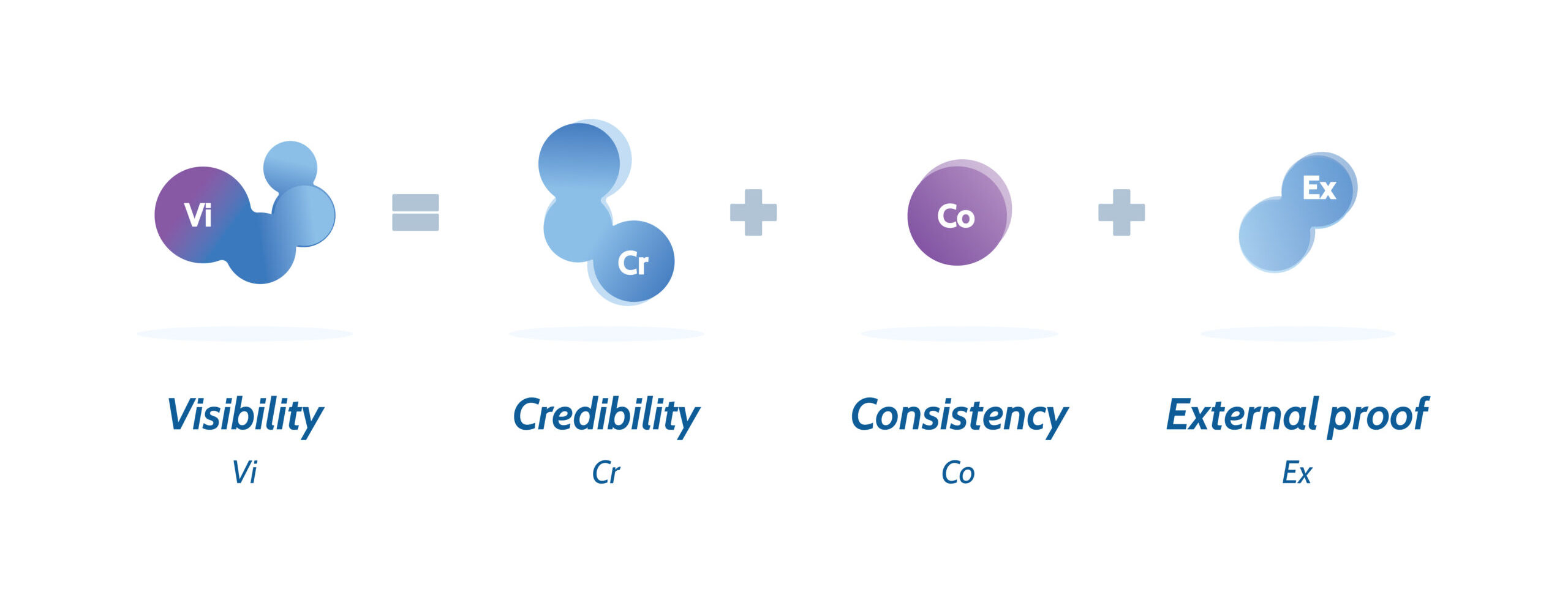
Credibility comes from depth: original thinking, real experience, and insight that goes beyond surface-level commentary.
Consistency comes from reinforcing that expertise across channels and over time.
External proof comes from third-party validation; particularly trusted media.
This last element is where many brands fall short, with media presence often overlooked.
Why media has become a credibility signal
Media used to play a largely amplifying role. Coverage helped to extend reach, raise awareness, and support marketing campaigns.
Today, the media plays a much more structural role. When AI tools generate answers, they rely on signals of trust. Those signals are often derived from:
● Reputable publications
● Independent commentary
● Repeated references across authoritative sources
Appearing consistently in trusted media tells AI systems (and human buyers) that your brand is not simply claiming expertise, but has earned recognition for it.
This duality is particularly important in B2B marketing, where buying decisions are complex, high-stakes, and rarely made on the basis of a single interaction.
Media coverage provides something extra that owned content alone can’t achieve: independent validation.
Media as proof, not promotion
One of the most common misconceptions we encounter is that media is about promotion.
In reality, the value of media lies in proof and validation. A well-placed interview, opinion piece, or data-led feature does more than generate awareness.
Rather, it achieves the reinforces expertise through a third-party lens, places your brand within a broader industry conversation, and creates a reference point that others, including AI systems, can draw from.
We’ve seen this play out repeatedly. Brands with strong SEO foundations but limited media presence often struggle to appear in AI summaries.
Meanwhile, competitors with fewer owned assets, but stronger media visibility are cited more frequently and remembered more readily.
In an AI-led environment, being referenced matters more than being found.
Media’s role within the Golden Triangle
This is why media sits at the centre of the modern marketing Golden Triangle alongside thought leadership and Generative Engine Optimisation (GEO).
● Thought leadership provides the substance: original ideas, insight, and perspective.
● Media validates and distributes that thinking through trusted, independent channels.
● GEO ensures content is structured so AI can interpret, reference, and reuse it.
Each element reinforces the others.
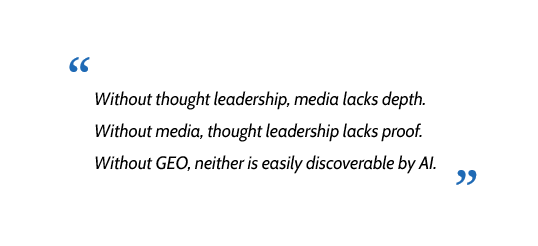
Together, they form an ecosystem that supports long-term visibility — even as clicks decline.
Why media increases AI citation potential
AI systems look for patterns. They prioritise sources that appear repeatedly, consistently, and across trusted environments. Media coverage creates those patterns.
A single piece of coverage can act as an anchor. Multiple placements reinforce authority, whether it is across publications, podcasts, or industry platforms. Over time, this pattern builds a trail of references that AI tools recognise and reuse.
Research into AI citation behaviour consistently shows that brands with strong third-party visibility are more likely to be referenced in summaries and overviews. This is not about volume, but about quality and credibility.
The effect of brand visibility then compounds. Each credible mention increases the likelihood of the next.
What happens when media is missing
We often work with brands that invest heavily in content and optimisation but see diminishing returns. Their sites are technically strong. Their messaging is clear. Their expertise is real. Yet they struggle to surface in AI-generated answers.
The missing link is usually media. Without independent validation, content remains siloed within owned channels. AI systems are less likely to prioritise the content over sources reinforced by third-party credibility.
In practical terms, this means competitors appear earlier in summaries, brands lose visibility despite strong fundamentals, and expertise goes unrecognised outside internal ecosystems. In a zero-click world, this invisibility is costly.
What strategic media looks like today
Effective media today looks very different from traditional PR. It is:
● Selective, not scattergun
● Insight-led, not announcement-driven
● Consistent, not campaign-based
The most effective programs focus on placing brands where buyers already seek reassurance, positioning leaders as credible, informed voices, and reinforcing a clear narrative over time.
This requires close alignment between messaging, thought leadership, and distribution — and a deep understanding of how media works in practice.
Why experience matters
This is where the choice of a marketing partner becomes critical. Media in the age of intelligent search isn’t about press releases or one-off hits. It requires judgement, relationships, and a clear point of view on what genuinely matters to audiences and editors.
At Manning & Co., strategic media and PR have been part of our core offerings from day one. We don’t operate as a traditional PR agency. Instead, we focus on thoughtful, strategic storytelling grounded in insight and relevance.
Through our work with B2B brands – particularly in technology, consulting, and professional services – we’ve helped clients build credible positions in crowded, complex markets.
Our approach combines original thought leadership, data-led industry insight, and strong, trusted media relationships.
Because our team works with journalists every day, we understand what makes a story resonate– and what earns long-term trust.
Media as a foundation, not a tactic
In the age of intelligent search, media is no longer optional. It’s a foundational signal that shapes perception long before buyers engage directly.
When media is aligned with strong thought leadership and a clear GEO strategy, brands remain present, even when clicks disappear. This is not about chasing attention. It’s about building brand authority that lasts.
Are you rethinking how your brand shows up in an AI-led world?
If you’re looking for a partner with proven experience in thought leadership and media, please get in touch with us today.