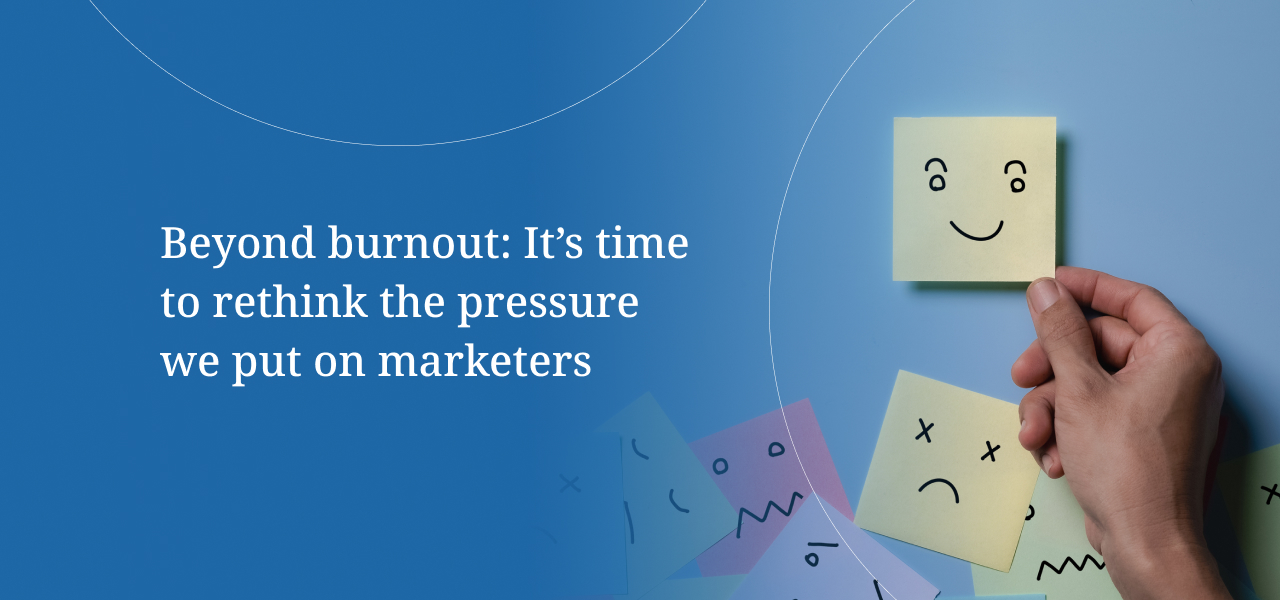
With World Mental Health Day approaching on 10th October 2026, workplace mental health is in focus across diverse workplaces and industries. But for marketers, the mental health conversation needs to go beyond simple wellbeing initiatives and individual resilience; it needs to be driven from the top, at the senior leader level, and embedded all the way down the line.
Unfortunately, employee burnout has become an uncomfortable reality for many people working in marketing. 7 in 10 professionals across the media, marketing, and creative sectors experienced burnout over the last 12 months. I personally know many marketers who have experienced burnout in recent times, and I am not ashamed to say that I know the burnout feeling very well myself. The industry and the work itself are relentless, and the pressure is only intensifying.
The latest industry data suggests that the pressure has not gone away. Marketing Week’s 2026 Career & Salary Survey found that more than 65% of marketers felt overwhelmed during the previous year; more than 60% felt undervalued; and more than 55% were emotionally exhausted. Also, more than half of leaders said they no longer enjoyed work that had previously engaged them, while over 42% felt unable to tell their manager or wider business how they felt.
These aren’t just numbers; these insights represent tired, overworked people. People at risk of burnout.
Exhausted, irritable, and mentally drained, many marketers end each day with little left to give. That should concern all of us because the burnout conversation has too often focused on the individual, not the broader industry pressures they are under.
We often ask: how can marketers be more resilient, manage their workload, set boundaries, or switch off?
Those things matter, but they address only part of the problem.
But the real issue isn’t just workload; it’s the heavy pressure we’ve normalised in marketing.
Marketing has become an increasingly high-pressure function
Marketing has always been demanding. Deadlines move quickly. Expectations are high. Results are visible. There are campaigns to deliver, audiences to understand, channels to manage, and commercial outcomes to prove. And then there is the constant questioning about the value of marketing, with growing tension between sales performance and marketing in most organisations.
But in recent times, the role of marketing itself has changed dramatically.
Marketers are now expected to be strategists, creators, analysts, technologists, and commercial drivers all at once. And as the role has expanded and diversified, the landscape underneath it has become more complicated; particularly with the rise of AI disruption.
AI is transforming how we create, search, analyse, and communicate. Consumer behaviour is shifting. New platforms and channels are emerging at an extraordinary pace. Expectations around speed and personalisation are rapidly increasing. And marketing is under constant pressure to be across it all while still demonstrating its contribution to growth.
Then there is the added pressure – exacerbated by the prolific adoption of AI – where everyone is now a marketing expert. The average person can now have a voice, opinion, and view of how marketing should be done and what the marketing team is or isn’t doing right. This is creating roadblocks for experienced marketing professionals to share their knowledge and expertise.
From our recent roundtable discussions with our marketing community in both Australia and Singapore, many marketers feel alone and unsure where to go from here. They are often isolated in their roles; they feel like their executives don’t understand them; and they are having trouble with the fast-changing world placing so much pressure on their day-to-day workloads.
Marketers aren’t just busy: they’re overwhelmed, undervalued, and emotionally exhausted. We see it within our community all the time. We get it. And we know that more needs to be done to fix it.
When sales isn’t delivering, the marketing department may be asked for better leads. When growth slows, marketing is asked to generate more demand. When the brand isn’t getting attention, marketers are asked to fix the positioning. And when the business isn’t differentiated, marketers are expected to make it stand out.
Some of those challenges genuinely belong to marketing, but marketers can’t solve every business problem.
The real problem is not just workload, but the relentless expectations that keep rising as the goal posts continuously shift.
AI was supposed to help, but expectations keep growing instead
AI is changing how marketing gets done. At the same time, AI disruption is raising the market’s expectations of service delivery, timing, productivity, and brand recognition.
If a task that once took a day can now take an hour, that efficiency can quickly become a new benchmark for output. That’s why marketing teams are being asked to adopt AI while budgets remain constrained and high-level expectations keep increasing.
Gartner’s 2026 CMO Spend Survey highlights this very real tension: marketing budgets remain effectively flat, while AI is becoming a significant investment priority. Yet only 30% of global organisations report mature or fully developed AI readiness capabilities.
Tension is also growing between what AI can produce and what audiences actually value. Another Gartner study found that 57% of consumers say AI-generated content has made them less trusting of brand messaging, while 43% say they now rely more on real people for information and recommendations. People are getting better at identifying ‘AI slop’ and there are the early signs of a consumer backlash emerging against the use of AI in branding, marketing, and messaging.
And all the while, marketers are faced with an internal environment that is promoting AI usage. The market keeps demanding that people across an organisation use AI to produce promotional material and their own content. This is rendering it even harder for marketing teams to police quality work while protecting their brand’s reputation; yet marketers are also being held responsible and accountable for the brand and the way it is viewed.
For modern marketers, the bar isn’t just set to producing content faster. Rather, it’s set to delivering greater expertise, creativity, and a human perspective. This, too, places great stress on marketers.
AI can speed up production. But it can’t replace the creative thinking behind good marketing.
That distinction matters when we consider burnout. If additional demands immediately absorb the time saved through AI, marketers aren’t being given more capacity to think, create, or recover. They’re being asked to keep pace with a much higher baseline.
The question, then, isn’t whether marketers should use AI. The real question is whether today’s organisations are using AI to give people more capacity and helpful tools – or are they simply finding new ways to ask more of their people.
Burnout isn’t a resilience problem
We must be careful not to make burnout an individual responsibility or personal resilience problem.
Resilience, boundaries, and wellbeing support matter, but if the work environment creates ongoing and unsustainable pressures, asking people to cope better is not a solution.
Marketing Week’s latest research is telling: more than two-fifths of marketers surveyed said they did not feel able to tell their manager or wider business how stressed they were feeling. That points to something bigger than individual resilience. It points to culture.
A business can have a wellbeing policy, an employee assistance program, and all the right language around mental health, while still creating an environment where someone doesn’t feel able to say, “I’m struggling.”
So, we need to look at the pressure-cooker itself, not just how people respond to it.
Are we creating unnecessary urgency, treating every request as a priority, and expecting constant availability from our people? Are we piling on responsibilities without taking anything awa, just because technology makes it possible? And are we giving marketers the time and space they need to think creatively and do their best work?
Perhaps most importantly: are we recognising when a problem doesn’t belong to marketing?
These aren’t just questions about productivity or performance. They’re questions about the working environments we create – and the impact those environments can have on people’s mental health.
Busy isn’t the same as productive
Marketing also has a deeply rooted cultural problem we need to challenge. Being busy all the time, or being seen as busy, is often still treated as a badge of commitment and engagement.
Full calendars look productive. Late nights appear dedicated. Fast responses look impressive. A team constantly producing can appear high performing and engaged.
But constant busyness erodes what marketing needs most: strategic thinking, creativity, curiosity, and perspective.
A marketer with no time to think isn’t necessarily more productive. They’re just busier.
And as the marketing landscape grows more complex, having the time to think, dream, and plan is a marketer’s most valuable resource. Because great marketing doesn’t only come from the ‘doing’; it comes from the thinking.
At M&C, we’re pausing because the industry needs to rethink its pressures
At M&C, we’re putting these insights and much-needed opportunities for thinking into action. For World Mental Health Day, we’re taking a day off as a team. It is important time to step away from work, recharge, and look after our wellbeing, so we can return to work feeling refreshed.
Sure, it’s a small action, but it reflects a bigger belief: caring for people’s mental health must be part of how we work, not just something we talk about.
Marketing will always come with pressure. After so long in the industry, I get that. There will be deadlines, ambitious goals and periods when we need to move quickly. But constant pressure shouldn’t become the norm.
For us, this means sustainable, high-performing teams start with sustainable ways of working. But this is bigger than M&C, and the industry needs to look honestly at the expectations being placed on marketing teams – whether that is internal or external.
If we want better marketing, we need to create the conditions for people to do their best work. It should make us uncomfortable because if seven in 10 people across media, marketing and creative sectors have experienced burnout, we cannot keep treating it as an inevitable part of the job.
We need to change the conditions that drive burnout. That starts with changing the minds of business leaders and educating them on the current world of marketing and what is required and needed to grow their brands in a digital age. It also requires removing unnecessary pressure and not succumbing to purely a short-term view of the business. Instead, leaders need to move towards approaching things with a medium-to-long term view.
If we want a healthier, more creative, and more effective marketing industry, we can’t just ask marketers to cope better. We have to rethink and change the pressure itself. That is why M&C will continue to support our community of marketing professionals through our community initiatives while also spending time with executives educating them about what is reasonable and necessary in modern marketing as we aim to shift the narrative while supporting the industry.